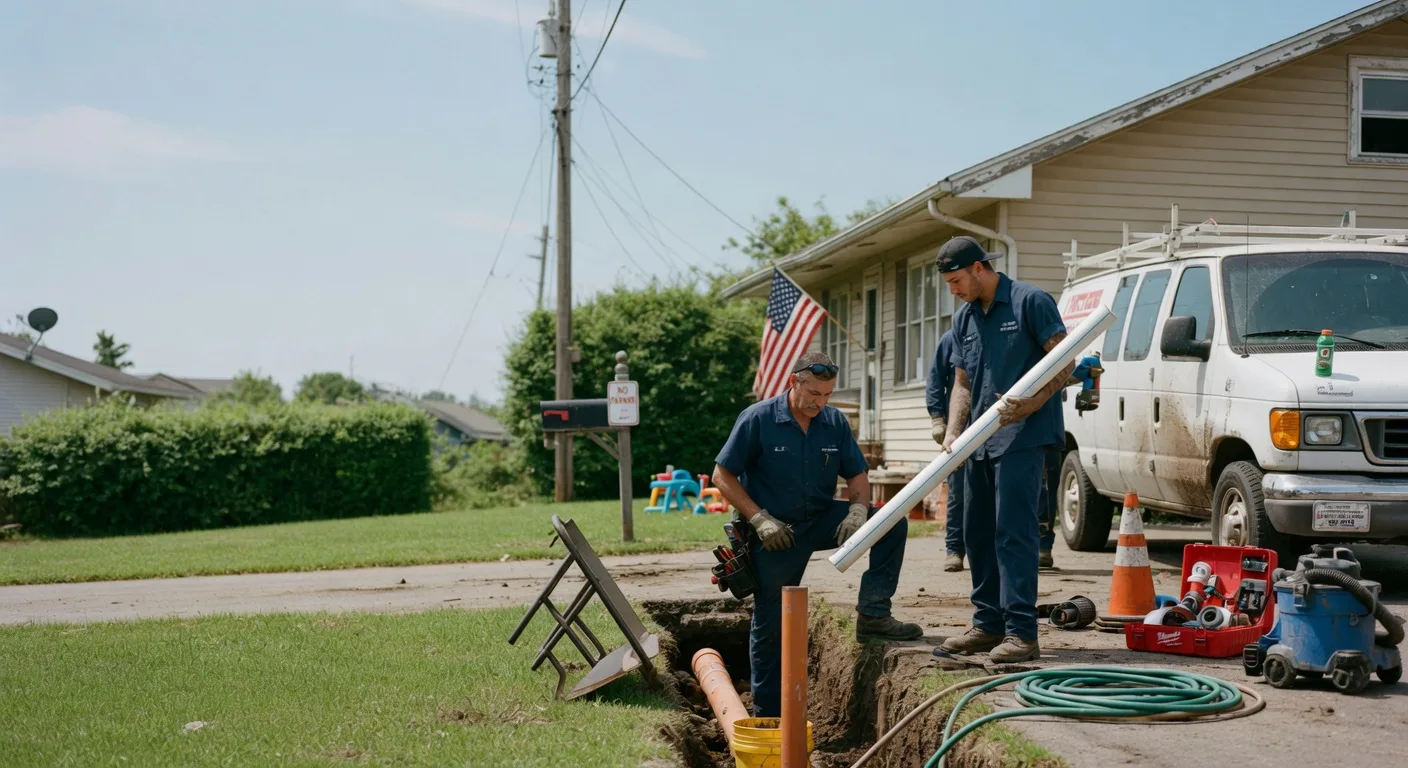
Why does the toilet gurgle when the washing machine drains?
Gurgling means air is being pushed or pulled through a water trap, and it happens when the drain system cannot move water and air freely. A washing machine dumps a large volume of water fast. That surge travels down the drain line and pushes air ahead of it. If the main line is partly blocked, that air has nowhere to go and bubbles back up through the nearest trap, often the toilet or a shower. A blocked vent stack does the reverse. Vents let air in behind draining water so it flows smoothly, and when a vent is plugged by a bird nest, leaves, or debris, the draining water pulls air through the traps instead, and you hear it as gurgling. Either way, it is a sign the whole drain system is under strain, not just one fixture. A single slow toilet is a local clog, but gurgling that follows other fixtures points to the main line or the vent. Keep the washer and other big loads off until it is checked, since a partial blockage can turn into a full backup. A camera inspection shows whether the cause is roots, a bellied pipe, or scale. A plumber in Obion, TN can find it, and Expert Plumbers Co can make the introduction.
Here is a simple test to separate the two causes at home. Run water in one sink only and listen. Then flush a toilet by itself and watch the tub and the sink for movement or bubbling. If the sounds appear only when a particular fixture runs, the blockage is probably in the branch serving that area. If they appear whenever the washer drains, regardless of what else is running, the main line or the vent is the more likely suspect. A roof vent can be checked visually from the ground for a bird nest or heavy leaf buildup, but nobody should climb onto a roof to do it. In older homes, a vent run through a wall can corrode or sag, while newer homes sometimes use air admittance valves under sinks that can wear out and let a trap siphon dry. Tell the plumber what you noticed and when.
Does hard water cause drain problems, or only water heater problems?
The bathroom sink used to run fine. Now it drains a little slower each month. That slow creep is the sign of scale, not a clog.
Hard water does more than coat a water heater. Minerals from the supply side leave a chalky layer inside a trap. In a bathroom line they bind with soap residue into a hard, grey film. The bore narrows a fraction at a time, so you notice a gradual slowdown rather than a sudden blockage.
Old cast iron is a different problem. Inside drain pipe that has been in the ground or a wall for decades, rust forms lumpy mounds called tubercles. These are not hard-water minerals. They are the pipe corroding from within, and they snag grease and paper.
The two tools do different work. A cable punches a hole through the build-up. Water drains again, but the scale stays on the wall and the line narrows again. Hydro jetting strips the wall back to the pipe surface.
Jetting old iron hard without looking first is a gamble, because thin, flaking pipe can fail under pressure. That is why a camera inspection comes first on old iron. It shows wall condition and cracks before anyone sets the pressure.
Safe homeowner check: find out whether one fixture is slow or every drain in the house is, then clean the visible stopper and trap.
Stop running water and call now if several drains slow together, or water backs up at a floor drain. One slow bathroom sink is usually a cable or trap job. A whole-house slowdown in old iron often needs a camera first and possibly jetting.
Expert Plumbers Co is a referral service. We connect you with an independent local plumber in Obion, TN. Call (380) 262-9173.
A water softener changes the picture a little, and it is worth telling the plumber if you have one. Softened water leaves less mineral scale, but it can feel slippery and does not stop soap and hair from building up on the pipe wall. If your water is hard and you have no softener, the mineral film inside traps and short branch lines is the main cause of the slow creep. A simple habit helps: use a hair catcher in the tub and basin, and rinse the sink with hot tap water after use so soap does not cool and settle on the wall. Do not rely on vinegar or store-bought descalers to clear a drain, as they only treat the surface. In newer homes with plastic pipe, scale is mostly a trap and fixture issue. In older homes with iron or galvanized pipe, scale and corrosion together can narrow a line enough that replacing a section is more sensible than repeated cleaning.
We run a cafe and the kitchen line keeps blocking. Is that the same job as a house drain?
Not quite. A kitchen line that blocks again and again is usually a grease problem, and that is a different job from a house drain.
A cafe pushes far more fat, oil and food solids down the pipe than a home does. The grease cools, sticks to the pipe wall and builds layer on layer. The opening shrinks each week. That is why the blockage returns on a short cycle.
A grease interceptor, also called a grease trap, sits between the kitchen and the main line. It catches fat before it travels downstream. It only works while it has room. Once it is overfull it stops holding grease and passes it straight into the line. So it needs servicing on a schedule, not just when something goes wrong. Many jurisdictions require an interceptor and expect records of each servicing. That is a code matter, so check with your local authority.
A cable machine punches a channel through the grease and leaves the coating on the wall. Water drains for a while, then the channel closes again. A commercial line usually needs hydro jetting, which uses high-pressure water to strip the wall clean. A camera inspection then checks the pipe underneath for cracks, roots or a sag that holds water.
One slow sink is a branch problem. Every fixture backing up points to the main line.
A blocked line in a food business is a shutdown risk, so timing matters. If water is rising near the prep area, stop using the sinks and call.
What the job involves depends on access to the line, how much has to be opened up, the condition of the pipe and any permit requirement. Expert Plumbers Co is a referral service. Call (380) 262-9173 and we will refer your cafe to an independent local plumber in Obion, TN.
Keep a servicing record and a routine. Write down the date each interceptor is serviced and by whom. Authorities that require interceptors usually ask to see those records.
Train kitchen staff on what goes down the drain. Scrape plates and pans into the trash first, fit fine mesh strainers in every sink, and never pour fryer oil down any drain, even with hot water, because it cools further down the line and sets. Hot water and soap only move grease along the pipe. They do not remove it.
Learn the warning signs of a full interceptor: slow draining at the sinks nearest it, a sour or rancid smell, or grease showing in the outlet chamber.
Set the jetting interval after a camera inspection shows how fast the coating builds, so cleaning happens before a lunch rush is lost to a backup. Mention any recent menu change toward fried or fatty food when you call.
My dishwasher leaves standing water at the bottom and the kitchen sink is slow too. Are they connected?
Yes, most of the time. The dishwasher drains into the same pipe as the kitchen sink, usually through the disposal or a connection on the tailpiece. If that shared pipe is partly blocked, both will slow down, and the dishwasher shows it first because it cannot push water out against the restriction.
Grease, food residue and soap film coat the inside of the kitchen drain and narrow it over time. A garbage disposal can pack ground food into that narrow spot. The result is water that sits in the bottom of the dishwasher after a cycle and a sink that empties slowly.
Safe checks you can do: look at the dishwasher filter at the bottom and clear any food. Check that the drain hose is not kinked behind the machine. If you have a disposal, make sure the knockout plug was removed when the dishwasher was installed. Run the disposal with cold water and see whether the sink drains better. Take off the trap under the sink with a bucket below, and clear what is in it. Skip chemical cleaners, which can damage the dishwasher hose and the disposal.
If the filter and trap are clean and both problems remain, the blockage is further down the kitchen line. A cable machine often clears a soft plug of grease and food. If it returns in a few weeks, grease on the pipe wall is the likely cause, and hydro jetting cleans the wall where a cable only cuts a hole through it. A camera inspection can show a sag, a damaged joint or roots further along.
Stop running the dishwasher and call if dirty water comes up in the sink during a cycle, if other drains in the house are also slow, or if you smell sewage.
If the sink drains fine once the dishwasher is off and the problem is only the machine, the cause may be in the appliance, such as the pump or drain hose, and that is a job for an appliance technician rather than a plumber.
Cost depends on access under the sink, how far the blockage sits, whether a cleanout is available, and how much has to be opened or replaced.
Expert Plumbers Co can connect you with an independent local plumber in Obion, TN when you call (380) 262-9173.
Since we put in a water softener, the floor drain or laundry drain backs up when it regenerates. Are they related?
The softener finishes its cycle and a minute later the laundry drain gurgles or the floor drain spits up gray water. You did not have this before, so it is fair to wonder if the softener caused it. In most cases it did not cause the clog. It exposed one.
During regeneration, a softener flushes brine and rinse water out through a drain hose, usually into a standpipe, laundry tub or floor drain. That water arrives in bursts, and the volume is sudden. If the drain line is clear, it carries the surge without trouble. If the line has a partial clog, such as grease build-up on the pipe wall, a root mat at a clay joint or a belly holding water, the burst is more than it can pass, and the water rises in the lowest drain.
The discharge also needs to be set up properly. Most plumbing codes require an air gap, a physical space between the end of the softener drain hose and the drain, so wastewater cannot siphon back into the softener. A hose pushed deep into a standpipe, or taped tight to it, can cause splashing and backflow of its own. Rules vary by area, so the installer or local building department can say what applies in Obion, TN.
The key question is how widespread it is. If only the standpipe backs up, the trouble may be the standpipe, its trap or the softener hose. If the floor drain, laundry drain and a basement toilet all react, the main drain is partly blocked, and the softener is just the first thing to push it over the edge.
Safe homeowner check: look at where the softener hose ends. Make sure it sits above the drain with a visible gap and is not kinked or pushed down inside the pipe.
Stop running water and call now if sewage is coming up through the floor drain, if water is spreading across the floor, or if you smell sewage.
A cable machine is often enough for a soft clog in a short branch. If roots, a belly or grease are suspected, the work calls for a camera inspection and hydro jetting.
Expert Plumbers Co is a referral service. We connect you with an independent local plumber in Obion, TN. Call (380) 262-9173.
Tell the plumber the problem started after the softener went in and when in the cycle it shows up. Ask them to check the air gap and the standpipe as well as the main. Scope depends on access to the line, parts for any standpipe or hose changes, how much has to be opened up if a section is damaged, and any code requirement.